The politics of sugar.

From its beginnings, the sugar industry has always been political. The production of sugar initially was only possible because of its heavy reliance on the slave trade and the aggressive colonisation of warmer countries. The use of indentured labour, which is about as close to slavery as you can get without it actually being slavery, was common and huge numbers of people were shipped around the world to service the labour intensive industry. The sugar industry tried to demonstrate that it had a social conscience by funding things that would be seen as good for people (in this country, not the slave labour) such as art galleries.

Fast forward to the last century and we can see how the sugar industry used its money to fund the scientific research community. The same research community that silenced John Yudkin when he tried to publicise the link he found between sugar consumption and heart disease.

This morning, I watched a report on tooth decay in children and how it is almost out of control in the UK where total extractions of all baby teeth due to decay are now common. I find that shocking and more so because everyone knows it is simply caused by sugar and can be prevented by reducing sugar consumption but we still don’t help our children to save their teeth.

Then today I read in the paper that the UK government has delayed Public Health England’s report on sugar consumption and health.

http://www.theguardian.com/society/2015/jul/13/government-delays-publication-of-plans-for-reduction-in-uks-sugar-intake
Strange that… I wonder why it’s a good idea to delay a report that may help people lead healthier lives, maybe lose weight, maybe not get heart disease. It must be something really important that would delay such an vital report?

One lump or two?

Just came across this article and wanted to share it…

… it’s about whipping cream and why it goes stiff and other stuff. By the way, you could always use the saved buttermilk from your homemade butter to start a sauerkraut culture.

Why was I whipping cream? Because berries are in season and I eat berries that are in season. Does my weight go up with the extra sugar load? Yes it does. 

http://www.seriouseats.com/2014/10/the-science-of-whipped-cream-butter-creme-fraiche.html

A gut feeling.

image

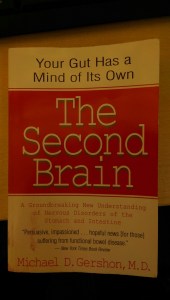
In a previous post I mentioned that I was going to read Giulia Enders’s book Gut. I have finished it now and I thoroughly recommend it. It’s written in an accessible style and is a fascinating journey from mouth to bum and tells you all you need to know to keep a healthy and happy gut and do efficient poos. In an earlier post I mentioned Michael Gershon’s book, The Second Brain, and was pleased to see he got a name check in Giulia Enders’s book in the section that discussed serotonin as the nerotransmitter of the gut brain – the second human brain. That’s the same serotonin that a lack of in the head brain causes depression.

The book was at its most interesting for me when she conjectured that the bacteria of the  gut might actually direct the body to do certain things or eat certain foods to keep them happy. There are particular gut bacteria associated with obese people. Could obesity simply be the enslavement of the rest of the body to keep those “obesity bacteria” fed and happy in the obese person’s gut? Maybe when I was in the supermarket the other day and got the urge to eat Roquefort, it was my Roquefort loving gut bacteria controlling my thoughts and it was them that had the urge… Not me…

Great book, good read.

This article is worth posting in full.

I am currently part way through a qualification in weight management for people suffering from obesity and diabetes. One of the statistics that sort of surprised me (and sort of didn’t) was that it is estimated that 25% of the WORLD’S population has Metabolic Syndrome (Syndome X). This rises to 35% in the USA. 

Metabolic Syndrome is a combination of central adiposity plus two of: raised triglycerides; high blood pressure; high blood glucose; and/or low HDL. Metabolic Syndrome increases the risk of heart disease, diabetes and stroke. It seems from the article in the Guardian that a huge number of the world’s population is headed toward an early end. I hope we have the facilities to cope. In my view and in my experience, a primal diet reduces all of the indicators for Metabolic Syndrome, most obviously central adiposity.

http://www.theguardian.com/society/2015/jul/07/heart-disease-plus-diabetes-can-knock-more-than-a-decade-off-your-life

“A combination of heart disease and diabetes can shorten your life by more than a decade, research has shown. Scientists came to the conclusion after analysing data on more than 135,000 deaths among more than a million study participants. They calculated the life expectancy reductions associated with a history of cardiometabolic diseases combining diabetes, strokes and heart attacks.
The lead researcher, Dr Emanuele Di Angelantonio, from Cambridge University, said: “We showed that having a combination of diabetes and heart disease is associated with a substantially lower life expectancy.

“An individual in their 60s who has both conditions has an average reduction in life expectancy of about 15 years.

Men of 60 with any two of the cardiometabolic conditions studied lost 12 years of life on average. The lifespan of those with all three conditions was reduced by 14 years. For women aged 60, the corresponding estimates were 13 years and 16 years of reduced life expectancy. The effects were even more dramatic at younger ages. Men of 40 with all three conditions could expect to have their life cut short by 23 years and women by 20 years.

Prof Jeremy Pearson, associate medical director at the British Heart Foundation, which part-funded the research, said: “The results of this large study emphasise the importance of preventing diabetes, heart attacks and strokes in the first place, through encouraging patients to live a healthier lifestyle and, where necessary, treating them with medication. “Once someone has developed diabetes, or suffered a stroke or heart attack, it is even more essential to address all their risk factors, such as their diet and the amount of physical activity they do, to lower their risk of a subsequent heart attack or stroke and give them the best chance of a longer life.

“Everyone should be aware of their risk of developing any of these conditions, and how they can reduce it. If you wait until you have developed one of these conditions before thinking about your wider health, you will already have reduced your life expectancy.”

I don’t usually buy food wrapped in plastic..

… but this week I did. I was in the supermarket buying washing up liquid, toilet paper and kitchen roll and was suddenly taken with the idea of Roquefort cheese, so I bought some. My butcher sells it too, wrapped in aluminium foil but I was in the supermarket… I took it out tonight to eat and I was struck by the amount of packaging. Plastic tray and lid wrapped in a plastic wrapper.

image

I wonder if the only purpose of the plastic wrapper is to be a place to print the cheese’s credentials and the government’s advice on how much Roquefort one should eat. Since when did government think it knew best about a healthy level of Roquefort consumption?

Never again.

From now on i will only buy my Roquefort from my butcher. In its original foil wrapper, from the cave, and cut to order. No plastic, no government advice. Just cheese wrapped in waxed paper. I will decide how much is good for me.

Ps. I like Roquefort 😋

A “new” best seller…

There’s a lot of discussion in the newspapers in the UK lately about a book that has surprisingly (the newspapers say) made the best seller lists. Its title is “Gut: The Inside Story of Our Body’s Most Underrated Organ” and is by Giulia Enders who is currently studying at Institute for Microbiology in Frankfurt. I am looking forward to reading her book and I see from the review that ther are already some things that a paleo person would agree with; digestive health is important to happiness; your gut flora are important; and squatting is a more natural position for defacation. All good stuff I think.

http://www.independent.co.uk/life-style/health-and-families/features/how-a-book-about-our-guts-has-become-a-surprise-bestseller-breaking-the-poo-taboo-10259412.html

I dont think it so surprising that its a bestseller. People seem to me to fascinated by what happens in their digestive system and with diseases such as acid reflux, irritable bowel syndrome and bowel cancer seemingly endemic in modern human society, I can see every reason why a book that seems to offer an explanation, even if it doesnt offer a cure, would be popular. Of course, I would say “Before you buy the book, just cut the grains and see if you feel better”.

Curiously, I am also reading a book about the gut at the moment, but one that was published almost 20 years ago. “The Second Brain” is a devoted description and explanation of the enteric nervous system of the gut by an exceptional scientist and writer. The author, Michael D. Gershon makes some of the same points that the reviews of  “Gut: The Inside Story of Our Body’s Most Underrated Organ” also attributes to Giulia Enders.  Michael D. Gerson coincidentally begins his book with the thoughtful observation that in science, as in all aspects of human existence, there is nothing new under the sun. Everything builds on what has gone before.

It will be interesting to see how far the two authors agree, despite their separation of nearly 2 decades.

wpid-wp-1434471778822

Just in case you were wondering, I got to The Second Brain, through a reference in Jill Miller’s “The Roll Model”. A great recommendation for anyone interested in self-myofacial release and trigger point therapy.

Asparagus season

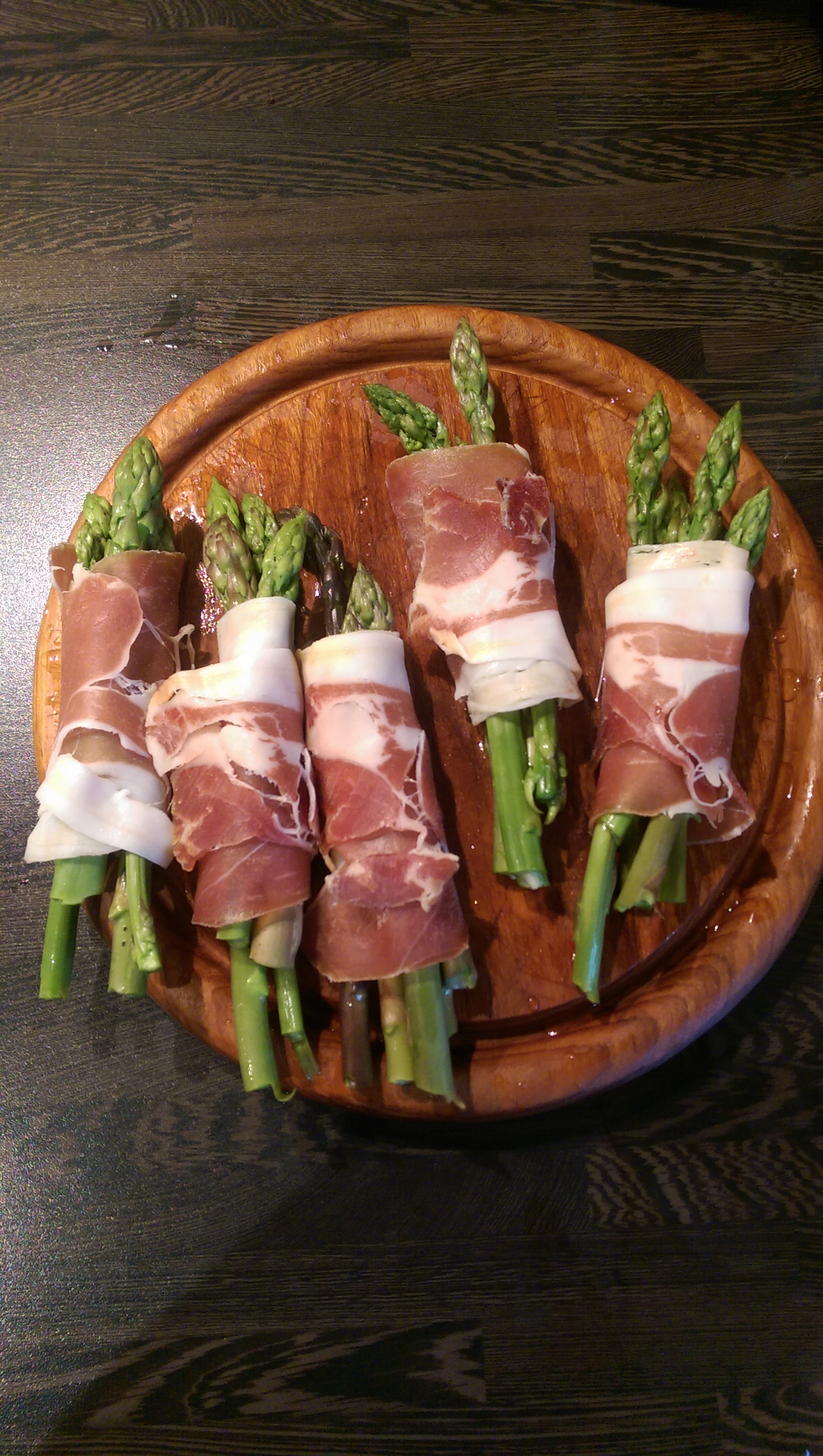
The first new crops start to arrive around this time of year. Herbs have been available for a few weeks and salad leaves are now ready. The overwintering brassicas have almost gone although there is still the odd cauliflower around but, most exciting and a real indicator of summer around the corner is the asparagus coming to its peak of production. I took the first few spears at the end of April but am now taking 20 or so a week. I like to cook them in as little water as possible and one of my favourite ways is on a griddle wrapped in good Parma ham. You make picturesque little parcels with the ham around the spears.

image

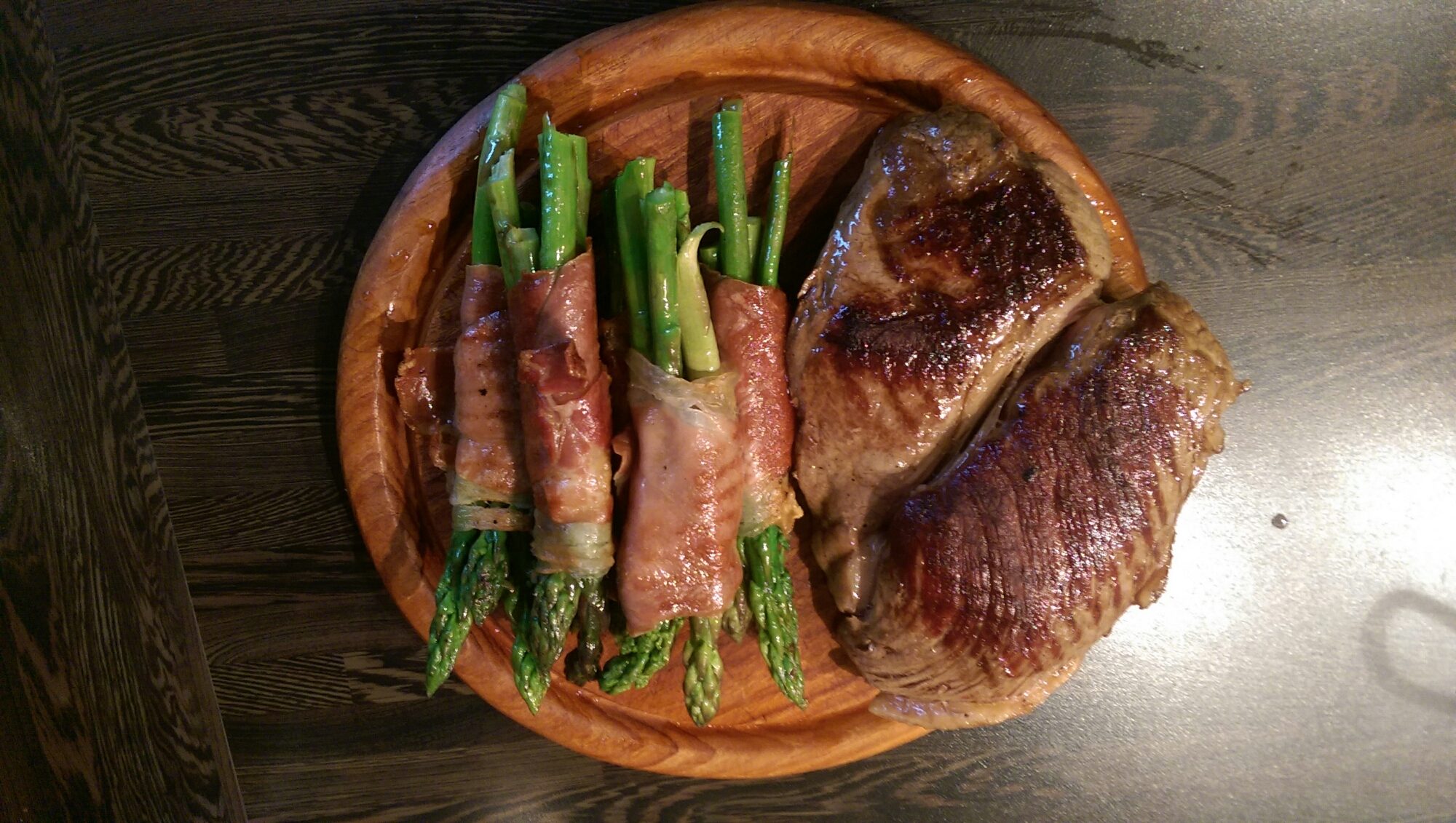
One or two parcels per person. Then simply griddle with your meat. Here is mine with a rump steak.

image

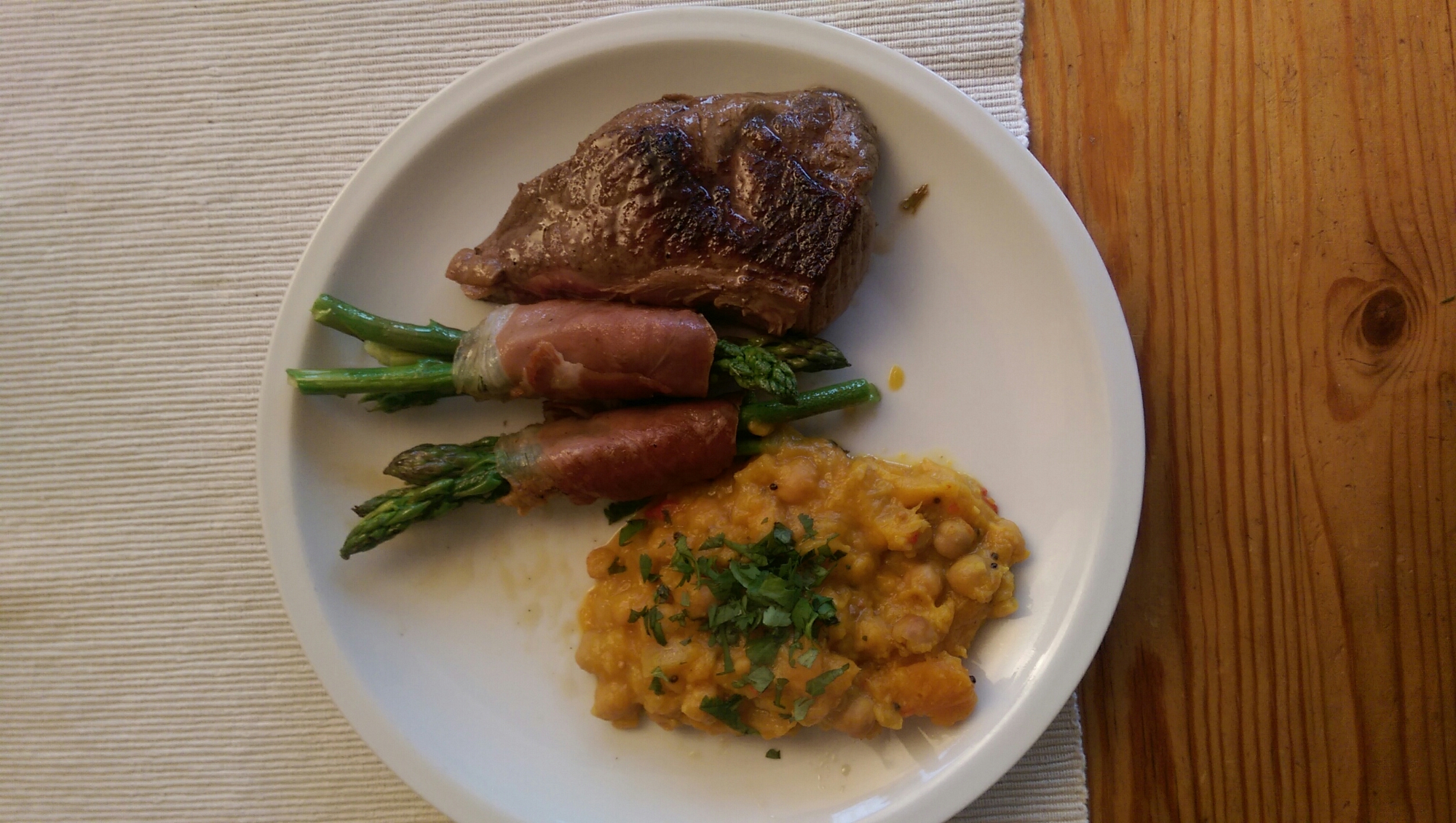
Just a couple of minutes cooking, turning to all sides, will soften and warm the asparagus and crisp the ham. Then back to the board to rest the food for a few minutes. I do think resting food improves its eating qualities.

image

Here it is served with a chickpea and pumpkin side dish. More about this delicious vegetarian stew in a later post.

image

Growing your own vegetables might not be strictly “hunter-gatherer” but it gives me a huge sense of well-being.

A hot breakfast.

“But what will I eat for breakfast?” Is a question I have been asked many times, although never one that has particularly bothered me, to be frank. Growing up, the only breakfast cereal that was in the house was cornflakes, which I found deeply unattractive, and I never liked milk that much either. I do remember enjoying bread and butter and the spicy Indian brinjal pickle for breakfast as a teenager. Maybe that is why I find this breakfast so enjoyable.

image

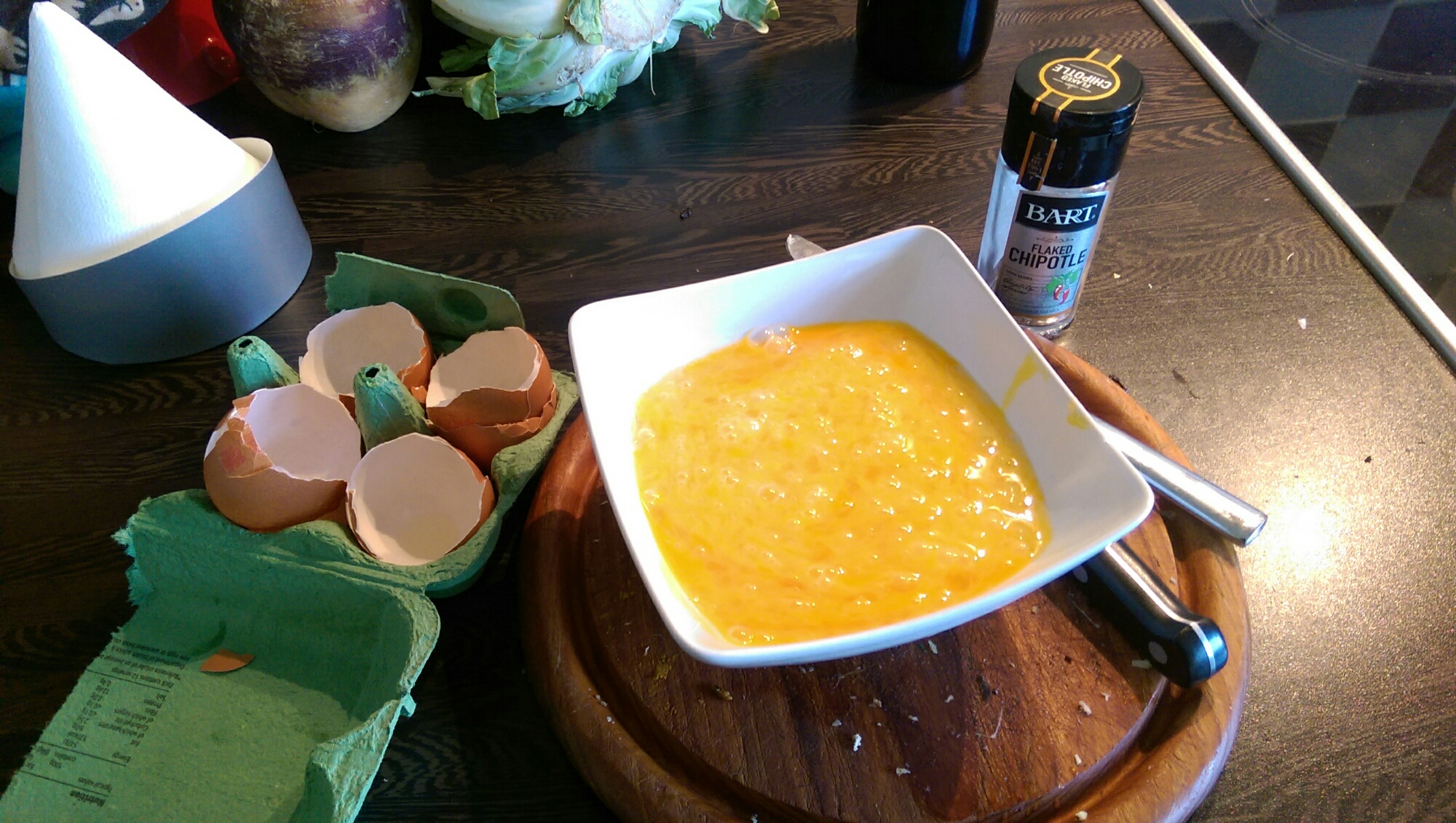
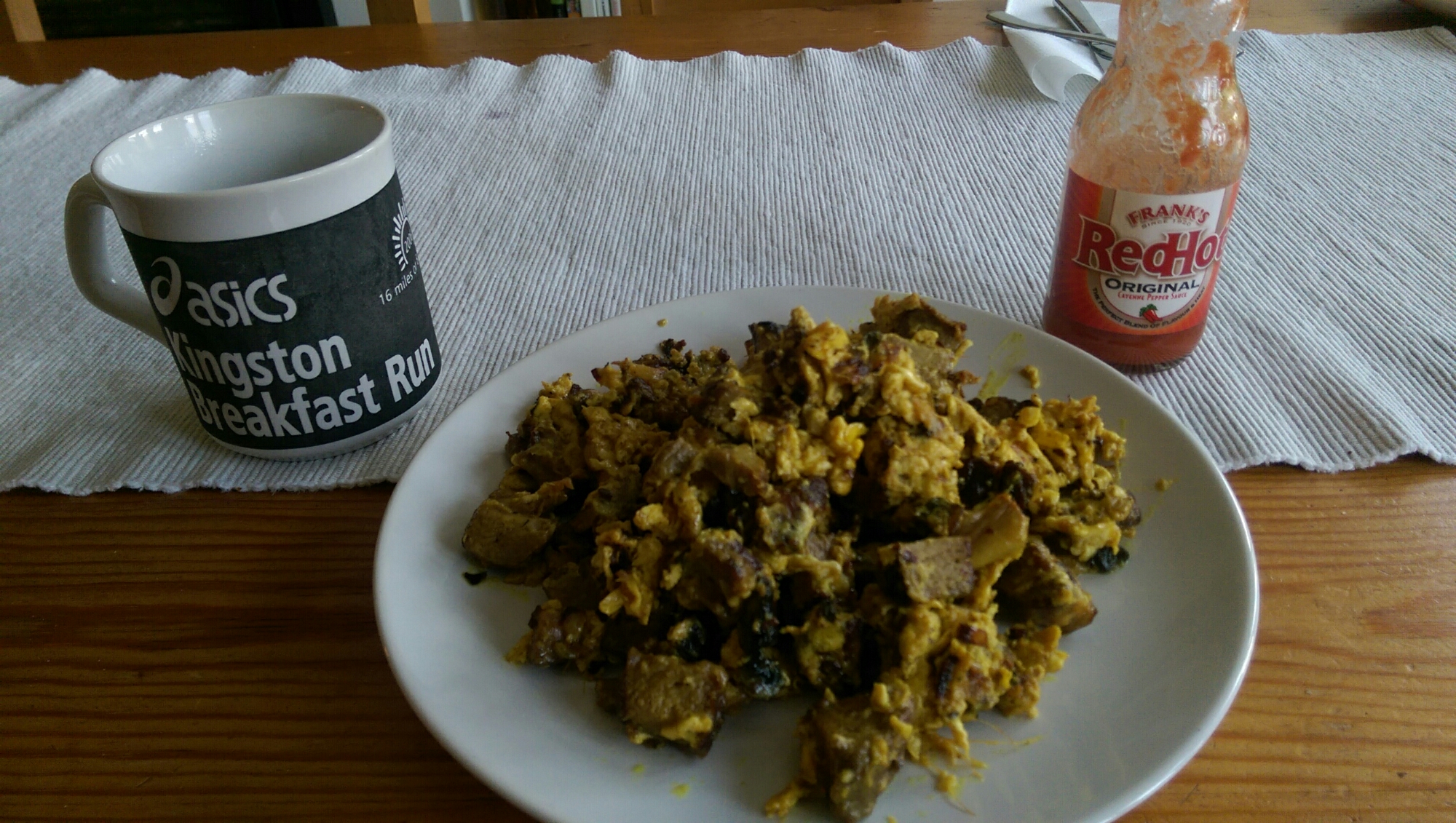
I take a small amount of finely diced onion or shallot and some grated fresh ginger and fry it off in a good fat with chilli flakes and turmeric. I rummage through the  vegetables in the fridge and see if there are any that will go in – a tomato often makes it but beans and leftover bits of peppers have made an appearance too. I then find some leftover over cooked meat, dice it small and mix it in. I have used everything you could think of steak, sausage, burger, roast pork, roast chicken. Whatever.

image

Then, as the contents of the pan heat up, I crack open some eggs and mix them up. I add a really good lump of butter to the pan and when it has melted, I scramble the eggs in the pan with all its contents. I season on the plate and eat it with a hot sauce. Messy but so good. Perfect after a cold early morning workout.

image

Running Rut …

Today’s post comes courtesy of my client Trevor, a talented marathon runner who had a personal best run in this years London Marathon. Thank you so much for sharing your experience and congratulations on a superb result.

********

I had set myself a pretty realistic target of 4 hours 15 minutes for this year’s London marathon, I’d missed a couple of long training runs, so I thought I’d take it easy, run the first 20 miles, and just plod the rest, essentially treating it as another long run, ready for the Edinburgh marathon in late May which I would set a sub 3.50 target.

On the eve of London I was more stressed than normal, this would be my 8th London Marathon and my 15th marathon overall – so I knew what I was doing!  Perhaps it was the decision to dismiss modern wisdom and avoid “carbo loading” and consuming gels during the run.  Was I wrong?  Would I “hit the wall”?

The reason for this arguably strange decision takes me back 6 months, I was in a running rut!

I’d managed to break the 4 hour barrier in Brighton in 2010 with a time of 3.57, then a 3.51 in London in 2012, and my fastest time, 3.49 in Edinburgh in 2013.  Although I had knocked 8 minutes off in 3 years I wasn’t really getting significantly faster, nor was I feeling fitter.

So in September 2014, after returning from the Medoc marathon (essentially 26.2 miles of drinking red wine and eating) I found a personal trainer with the main aim to lose weight and get fitter.  I was 16 stone 2 pounds (just under 103 kg’s), clinically obese (according to BMI) but “above average fitness” for my age – something that the initial fitness tests did prove, although there was a lot of room for improvement.

Along with weight training, kettle-bells, stretching, I attempted to adopt the “paleo” lifestyle that my trainer (Peter) followed.  I won’t lie – losing those potatoes, pasta, and bread from my diet was a real struggle, and although I “try” to keep on the paleo path I do verve off now and then much to the disgust of Peter!   At the start of each training session I “confess” my guilty treats, attempting to justify to both myself and Peter of my decisions, now before I consume anything vaguely “wrong” I make sure I have good excuse to hand (not that he accepts them!).

Although I have been active all of my life I am heavier than I should be, I’m not basing that statement on the scales, more on how I feel and the ever increasing jean sizes!  Every diet I have ever attempted to go on has lasted less than a week, I lose a few pounds then can’t sustain it, then give up.  So for me investing in a trainer meant I had to stand up, be weighed periodically and look someone else in the eye, not just pretend the scales were obviously lying.  Over the last 6 months I have developed a good relationship with Peter and we discuss progress, choices and next steps.  At no stage has he ever judged me and although I joke about my weekly food confessions at no point has he ever said I can’t eat something, he just highlights the pros and cons and lets me decide.  It must be working as I keep going back to see him and I am seeing results.

Anyway, so far I’ve lost 20 pounds (9 kg’s), reduced my overall body fat, lost a couple of inches off my waist and generally feel fitter and stronger.  As a “running geek” and Garmin owner I have stats dating back to 2008, so I know my times are getting quicker, even though I am the wrong side of 40.  In the Tempest this year I surprised myself by running sub 7.30 miles for the entire 10 miles – quick for me!  But running a marathon with no carbs or gels was going to be a challenge….

Usually I start off a race and get progressively slower, in the past I’ve aimed to get to 20 miles in around 3 hours knowing I should be able to manage to complete the final 6 miles in under an hour, but it’s always a struggle to keep any resemblance of my starting pace.

So fast forward to London 2015.  I started off slowly, mainly due to the crowds.  After a few more miles I felt fine, at 9 miles where I was due to meet family and friends I was well ahead of my 4.15 target.

I did have a minor mental wobble at 15 miles and consumed one of those dreaded gels – not because I felt energy depleted, but because I thought for sooner or later conventional wisdom would catch up with me.

At about 20 miles I started to realise that actually I was on for a great time, not because I was running fast but because I wasn’t slowing.  Driven by seeing family and friends again at the 24 mile mark, I kept running, thinking sooner rather than later I would grind to a halt.

Approaching the Embankment I realised that my speed was indeed changing, I was getting faster.  Briefly stopping to great my “supporters” I was told to keep running.

I crossed the line in 3.37.40, a massive 12 minutes off my PB – and more importantly I actually felt I had energy left in the tank.

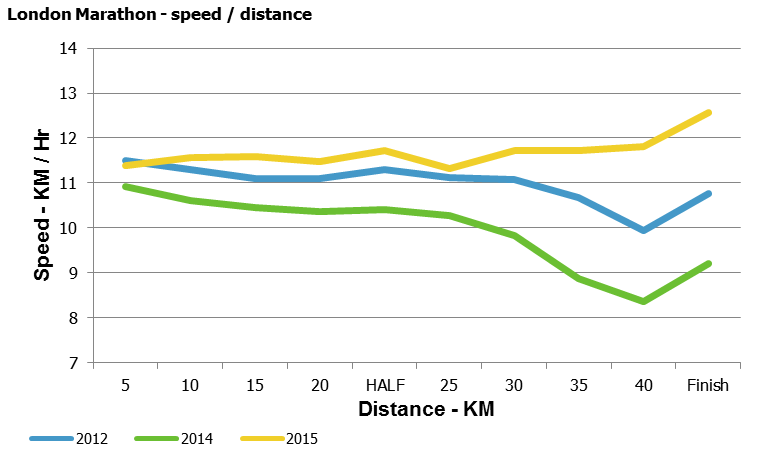
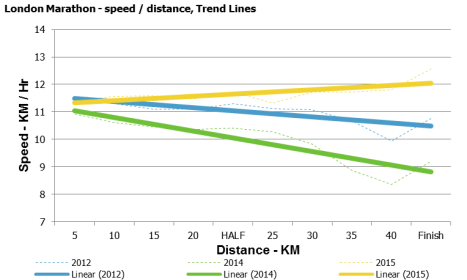
Now for the stats ….the first chart below shows my pace [in KM / hr] in the last 3 London Marathons:
graph 1 - Copy

Perhaps a better representation of this data is to add “trend” lines to the chart, this clearly shows the downward “speed” trends from previous years, and the upward trend from this year’s race:
graph 1

This increase in speed made a significance difference in my overall finishing position, the London Marathon provide stats for the final 7km of the route:

pic 1 - Copygraph 3 - Copy

In 2012 I passed 478 runners with 220 passing me, compare those with this year results it’s clear that my strength has significantly improved.

I’m not medically qualified in any shape or form, but stating the obvious losing weight and core strength work has make me fitter and stronger.  As for the carbs I didn’t miss them, I was able to run without carbo loading or taking my normal 4-6 gels during the race, (although I do regret taking the gel at15 miles but I don’t think it helped or necessarily hindered my performance), I also didn’t have that sickly sugar taste in my mouth to contend with.

It’s the first time I can ever remember that I have achieved a negative split, running the first half in 1.49.56 and the second half around 2 minutes quicker.

So in conclusion – losing weight, focused training and minimal carbs works for me!

Celtic Salt

Above the Austrian village of Hallstatt rises the 1900 meter mountain called Plassen. At about 800 meters up its eastern flank lies a hanging valley carved by a glacier millions of years ago.

image

This was a large Celtic settlement and given that in modern times Hallstatt has been a very small village, and still is, you have to wonder what was so important to Bronze Age people that they lived here, high in a mountain valley, in relatively large numbers and, by the richness of the graves, were apparently so wealthy. The answer is simple. Salt.

image 

In this valley was discovered a large Bronze Age burial site containing graves of huge archaeological significance. So important was this discovery that it gave its name to a period of human development – the Hallstatt Period.

image

Underneath the mountain lies very large salt deposits that have been continuously mined since the Bronze Age. The Celtic miners, men and women, lived and died here mining the salt, carrying it on their backs down the 300 meters to the Hallstatt lake where it was loaded onto boats and traded, providing these people with everything else they needed to live and their relative wealth.

image

Today the vast majority of salt is extracted as brine and pumped many miles away for processing along the salt pipeline. However, it is possible to buy unrefined rock salt, just as it is when it is dug out of the mountain. As you can see, it is full of colored minerals and particles of mountain rock. This is “raw” salt and is a wonderful addition to your diet. I see it as the same as putting rock dust on your vegetable garden. But please be warned, you need a ceramic toothed salt grinder to powder the fragments to the size that they won’t break your teeth!